About

Physio. Athlete.
Tradesman.

I'm a physiotherapist in Hampstead Gardens, and I rebuild people's bodies so they stop needing tune-ups. Most of the people I see aren't on their first opinion. They're on their third or fourth, after everything else settled it down and none of it held. I know that position well, because I spent years in it myself.

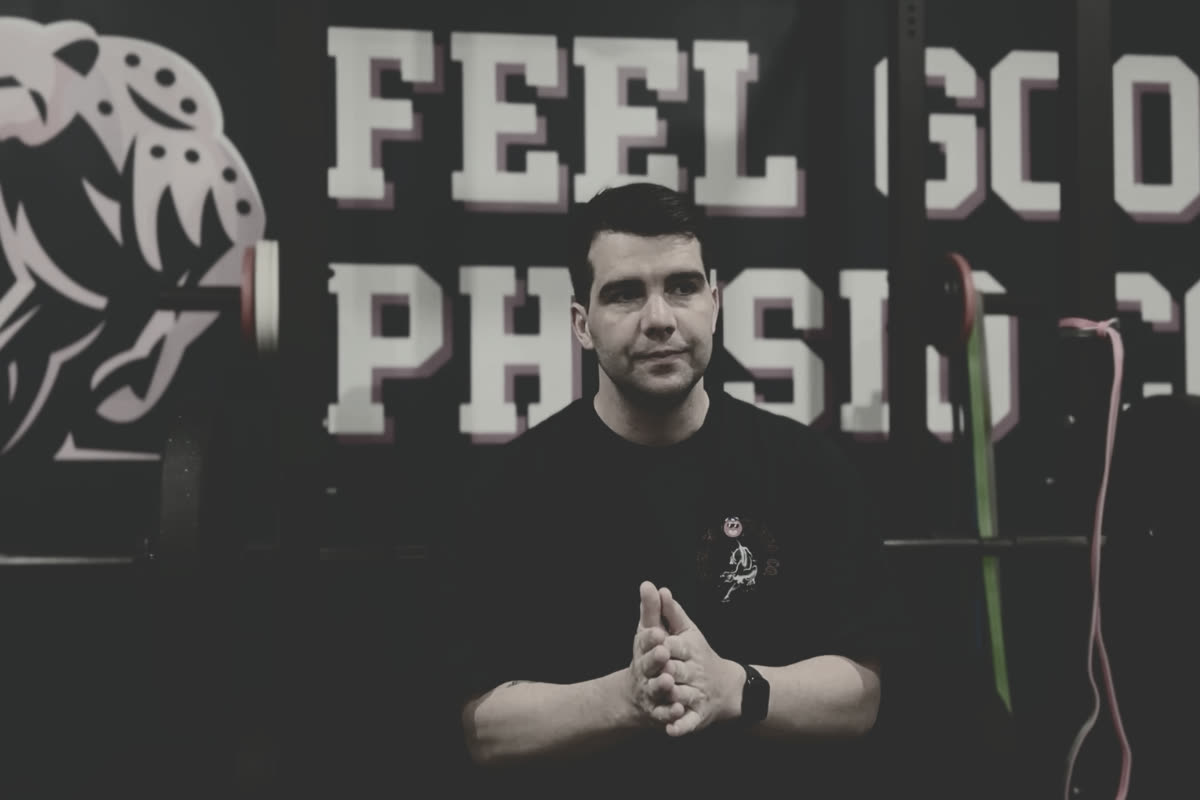
James Brown, physiotherapist and founder of Feel Good Physio Co.
The long way in

I didn't start in a clinic. I started on a building site.

I left school at 18 with no interest in going any further. I'd wanted to drop out in Year 11, and the deal I made with my mum was that I'd finish Year 12 and then do whatever I liked. What I liked was working with my hands, and solving problems, and not sitting in a classroom.

A bloke came through on a careers day in Year 11 and talked about trades. It ticked every box. Hands-on, practical, logical. Years later I'd realise physio ticks exactly the same boxes, but at the time the two things looked like opposites.

So I went and did it. Cabinet making lasted about ten weeks before I worked out it was hell. Plumbing lasted about three months, most of it at the bottom of a trench, and I hated every day of it. Then three years labouring, which I actually enjoyed. Good crew, hard work, and I have never been physically stronger in my life.

But I wasn't going anywhere and I knew it. Looking back the problem wasn't the work. It was that I'd decided who I was fairly early and stopped testing it. No goals. No plan. Just a quiet certainty that this was roughly my level and there wasn't much point aiming past it. I'd convinced myself I'd already burnt the bridges that mattered.

The part that made me a physio

I was 16, and I was told to rest until it stopped hurting.

I'd come to football late but I was good at it, and I could see it going somewhere. So I trained every night of the week except Friday, played Saturday, played Sunday, and did that until my body handed the bill over.

Hip and groin pain. Chronic tendon irritation and bone stress that built up over months rather than arriving in one moment. I carried it for three or four months before I did anything about it, mostly because I didn't want it to be real.

When I finally went, I was diagnosed with osteitis pubis. The instruction was simple and absolute: rest until there's no pain, and the moment you feel pain, stop again. Isometric holds, a lot of stretching, almost no load, and pain treated as a red light in every case.

I believed him completely. He had a serious reputation and had worked with high-level athletes, and I was sixteen and knew nothing.

It never worked. Not once did I feel it turning around. Every time I ran, every time I tried to push the load, the fear came with it. I lost most of an off-season. I stopped training with any intensity, stopped training for performance at all, and football stopped being something I enjoyed and became something I hoped to survive.

That was the start of it, not the end. What followed was years and a long list of practitioners. Somewhere in there I was told I would never play again, and that I was a waste of time to try.

The turn

Then someone explained that pain was protection.

Eventually I saw a physio who told me something nobody had: that the pain was protective rather than a measure of damage, and that the actual problem was that my tissue wasn't strong enough for what I was asking of it.

That was the whole thing. Not a scan, not a diagnosis, not rest. Capacity. And it explained every failed attempt at coming back, because none of them had built anything. They'd just lowered the demand until it stopped hurting and then sent me back to the same load that broke me.

I was furious about it, honestly. And it's the reason I do this.

Deciding to study was a different problem. I'd left school certain I wasn't the study type, and reversing that is harder than it sounds. What got me there wasn't ambition. I wasn't chasing glory. Change happens when the pain of staying the same outweighs the pain of changing, and I'd hit that point. I'd met the woman who's now my wife, I wanted a real career rather than a job, and I'd run out of other options. I had nothing to lose.

I laboured while I studied until the hours made it impossible, then went into retail at 24 and hated it. I never came close to quitting the degree.

Qualifications and registration

The formal bit.

Bachelor of PhysiotherapyUniversity of South Australia · 2019
Registered PhysiotherapistAHPRA · PHY0002320500
Australian Physiotherapy AssociationMember
First aid and CPRCurrent
Where I've worked

Change-rooms teach you to decide.

I spent three years as a sports trainer at Port Adelaide, across the Magpies in the SANFL and the AFL program. Training nights and early mornings, strapping, soft tissue work, and handling whatever came up on the track and on match day.

Since then I've been head physio at three clubs: Port District Football Club in the Adelaide Football League for two years, Para Hills Knights in the NPL for eighteen months, and Adelaide Croatia Raiders in State League 1, which is where I am this season. Head physio means all of it, not just the treatment table: training-night prep, load modification, diagnosis, rehab, and the match-day calls. I also travelled to Perth with the South Australian under-16 metro boys' basketball team for the national championships.

The thing you can't learn in a clinic is deciding under pressure. On a match day there's no time, no equipment and no second appointment. Someone is in front of you and a decision has to be made now. That makes you a considerably sharper clinician, and it carries straight back into ordinary practice.

It also teaches you what those calls cost. Concussion is easy, because the answer is always no. The hard ones are the soft tissue injuries at seventy-five per cent in an elimination final, where the player and the coaching staff get every piece of information and then make the call. Sometimes it holds. I've also watched a hamstring go in the second minute knowing exactly what was coming.

How I think

I don't manage injuries. I rebuild capacity.

See how I work

Most pain isn't damage, and it isn't age. It's capacity. Somewhere along the way life started asking more of your body than you'd built it to handle, and it broke in the gap.

So I don't chase the sore spot with endless passive treatment. I find why it happened, calm it down, and rebuild you past the point that keeps failing, until your body can handle whatever you throw at it.

There's a finish line, and getting you to it is the job. I discharge people once we're both satisfied the problem is under control and you're confident managing it yourself. You can always come back if something changes. But I don't believe in maintenance. If you need me fortnightly forever, I haven't done my job. Staying on top of it comes down to staying strong and managing load, and teaching you that is part of what you're paying for.

If you've been seeing someone every couple of weeks for two years and you're happy, keep going. If you've been doing it for two years and you're not actually better, then what you're getting is short-term relief while your nervous system settles, and the problem returns because nothing underneath it changed.

What I don't do

No needles, no machines, no hips out of place.

I don't do dry needling. I don't use ultrasound or shockwave. Hands-on work matters and I use it, mostly massage and joint mobilisation, but I don't use treatments I don't believe change the outcome.

I also won't tell you your hips are out of place, or that the problem is a tight muscle. Those aren't diagnoses. They're a very effective way of keeping someone coming back.

What actually works is prescribing the right exercise, explaining what's going on, and getting you to the point where you can manage it yourself. Anything less than that leaves you at the mercy of your injury. The goal isn't to finish pain-free. It's to finish confident.

Still in it

I'm not coaching from the sideline.

I'm in my own rebuild right now. I've put on more than fifteen kilos since my mid-twenties and gone years without training with any consistency, so I'm building strength and fitness back, and rebuilding the mental side along with it.

The goal is the Tour de Cure Signature Tour in March 2027, Sydney to the Gold Coast. Right now that means base work: zone two riding, kilometres in the legs, nothing glamorous. I train at the clinic and ride on my own.

I'm telling you that because it's the same thing I'll ask of you. A real goal with a date on it, and the unglamorous work that gets you there. I won't ask you to do anything I'm not doing myself.

Before you book

The questions I get asked most.

How much does it cost? +
An initial appointment is $150 for 45 minutes and a follow-up is $135 for 30 minutes. A 60-minute extended appointment is $250.
How many sessions will I need? +
It depends on what's going on and how long it's been going on for, so I won't pretend to know before I've assessed you. What I will promise is that you won't be strung along for sessions you don't need. When you're on top of it and confident managing it yourself, I discharge you.
Do I need a referral? +
No. You can book directly for any private appointment. A referral is only needed for WorkCover, DVA or a Medicare care plan.
Do you only treat athletes? +
No, and it's the most common thing people get wrong before they arrive. Anyone using their body is an athlete at some level. What I do is take the treatment principles used in high-level sport and apply them to everyone.
What should I expect from the first appointment? +
Not a cure. The first appointment isn't designed to send you home pain-free. You should leave it understanding what's actually driving the problem, what the plan is, and with some confidence that it's fixable. It takes time and commitment. It isn't a couple of manipulations and off you go.
Do you do dry needling, ultrasound or shockwave? +
No, and that's deliberate. I use hands-on work where it helps, mostly massage and joint mobilisation, but I don't use modalities I don't think change the outcome. What changes the outcome is loading the tissue properly and understanding what's going on.

Ready to start your rebuild?

Same-week appointments. It starts with a proper assessment.

Book appointment